Selected Work / Original Noir-Comedy Series Development
MEWZ — From Pitch to Pilot
Original Noir-Comedy Series Development
The building has ordinary problems. Mewz suspects extraordinary causes.
Explore the pitch-to-pilot execution ↓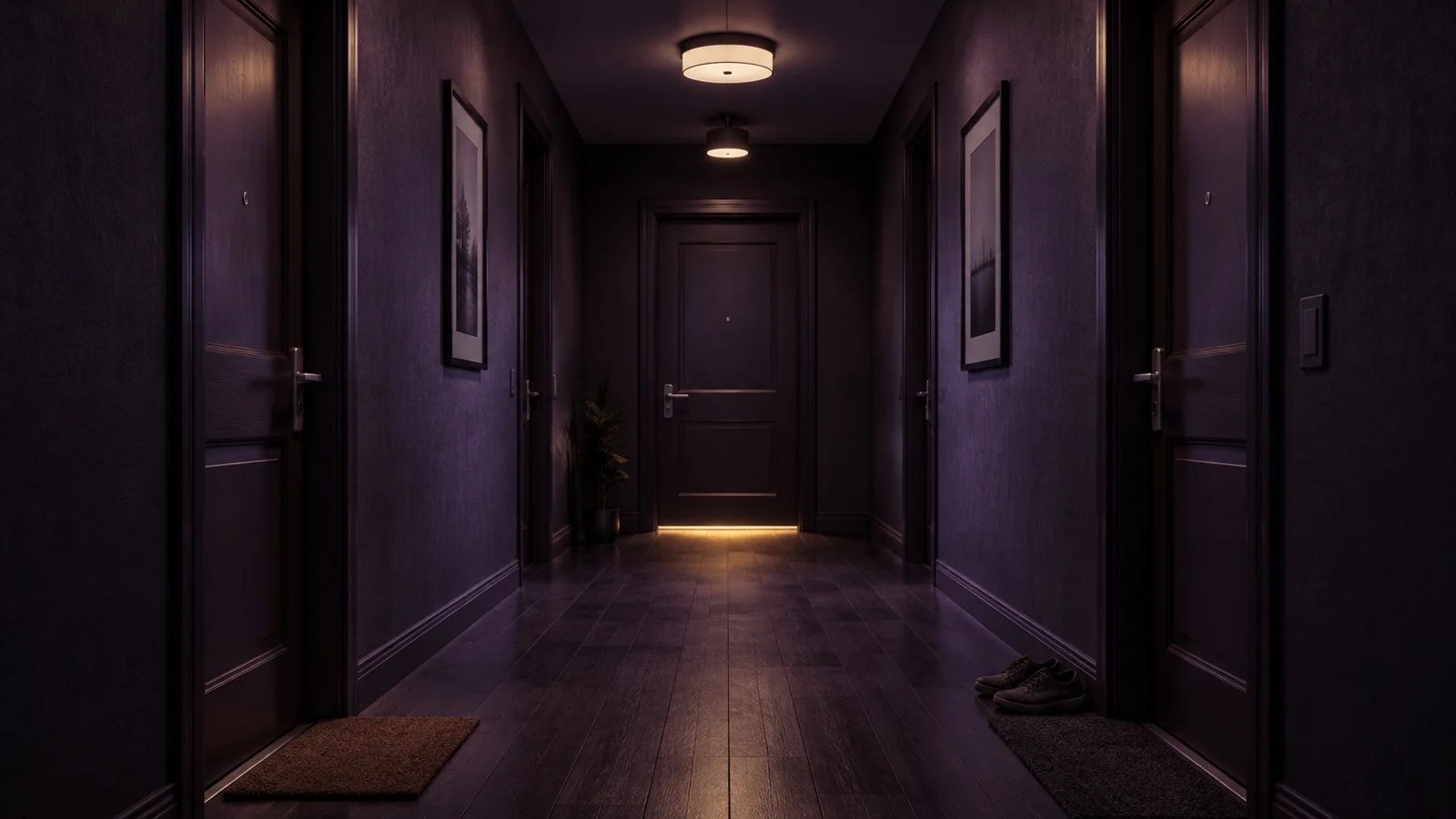
- Credit
- Adam M. Aguilera | Creator, Writer & Narrative Designer
- Format
- Live-action episodic web series
5–8-minute episodes - Status
- Original series in development
01 / The premise
An ordinary building.
An extraordinary capacity for suspicion.
An apartment building is full of unfinished conversations, misplaced packages, footsteps behind closed doors, and people with reasons to keep to themselves. To most neighbors, these are ordinary interruptions. To Mewz, they are the beginning of a case.
Mewz follows one woman's earnest investigations through a world that rarely deserves the gravity she brings to it. The comedy comes from the distance between a convincing theory and an ordinary explanation; the character remains sincere in both.
The narrative challenge
Build a reason for the next case.
The challenge was to make a small, recurring world sustain a short-form series: each disturbance needed to become a complete case within five to eight minutes, while leaving Mewz capable of starting another.
I built the episodes around her method rather than an expanding criminal mythology. The details can change; the dramatic pressure comes from how quickly she gives them meaning. Her need to tolerate uncertainty is a tension for continued character development, not an arc the pilot completes.
02 / The episode engine
The case ends.
The curiosity does not.
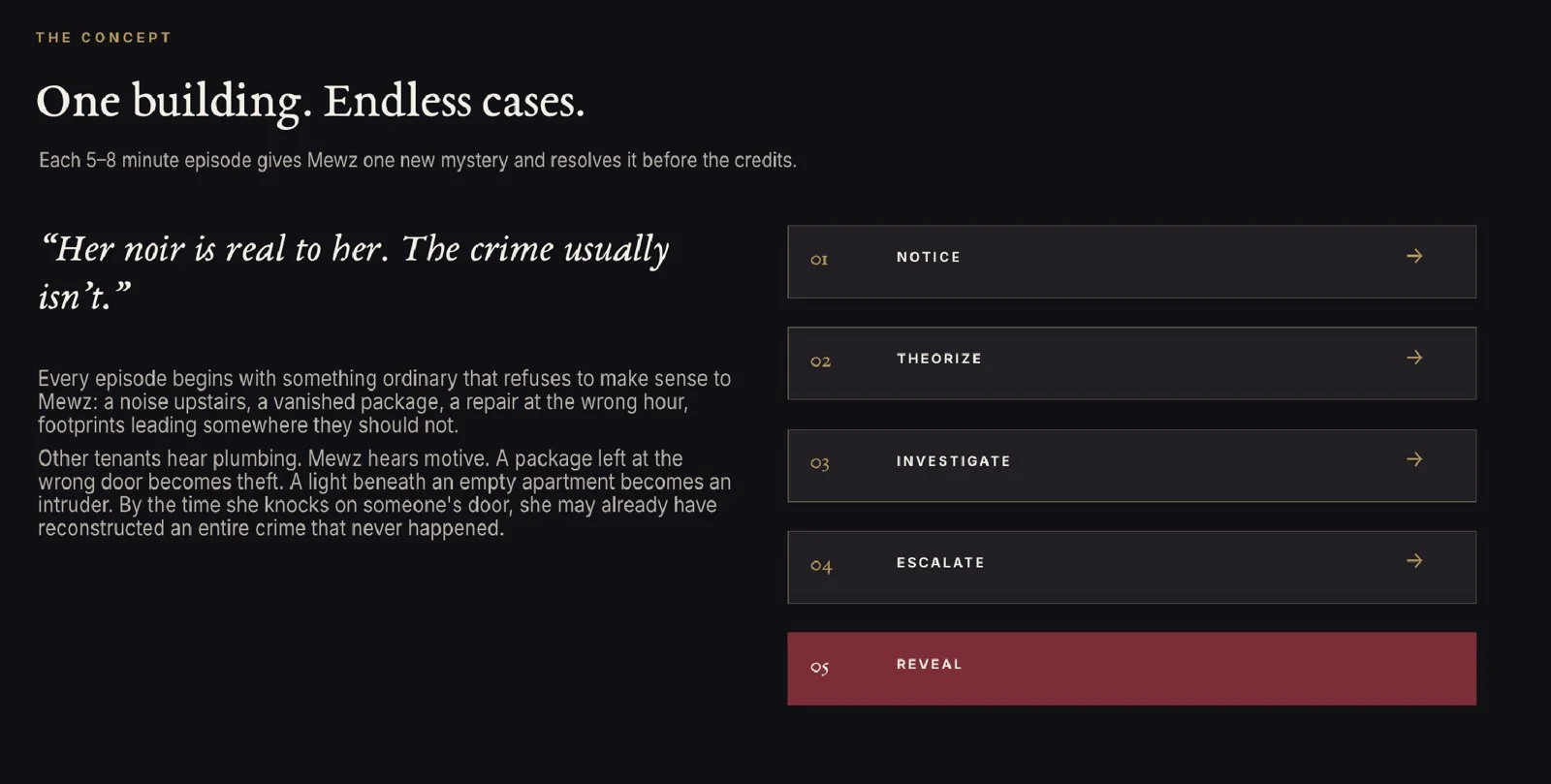
A repeatable progression turns a modest interruption into a case. Each proposed episode reaches an explanation; the next begins with a different disturbance.
- 01
Notice
A sound, object, or irregularity interrupts the ordinary.
- 02
Theorize
Mewz gives the detail a more serious meaning.
- 03
Investigate
She tests that reading against her neighbors.
- 04
Escalate
Incomplete context makes the theory feel stronger.
- 05
Reveal
An everyday explanation recasts what she observed.
Episode progression adapted from pitch deck slide 3. Each case resolves within the proposed short-form episode.
03 / Character decisions
Three neighbors.
One central investigator.
Mewz
The sole central investigator
Mewz organizes fragments into a story before she has enough evidence to trust it. Her attention gives the series its momentum; her imagination supplies both conviction and error. She drives each investigation herself.
Sander
Controls access
Sander values privacy and decides how much of his space or explanation Mewz receives. His resistance challenges her assumption that an unanswered question entitles her to an answer.
Noor
Helpful, inquisitive, literal
Noor asks questions, talks to everyone, and believes being informed makes her helpful. She is largely unaware of privacy boundaries. She answers what was asked; misunderstandings arise when Mewz expects context Noor does not realize she needs.
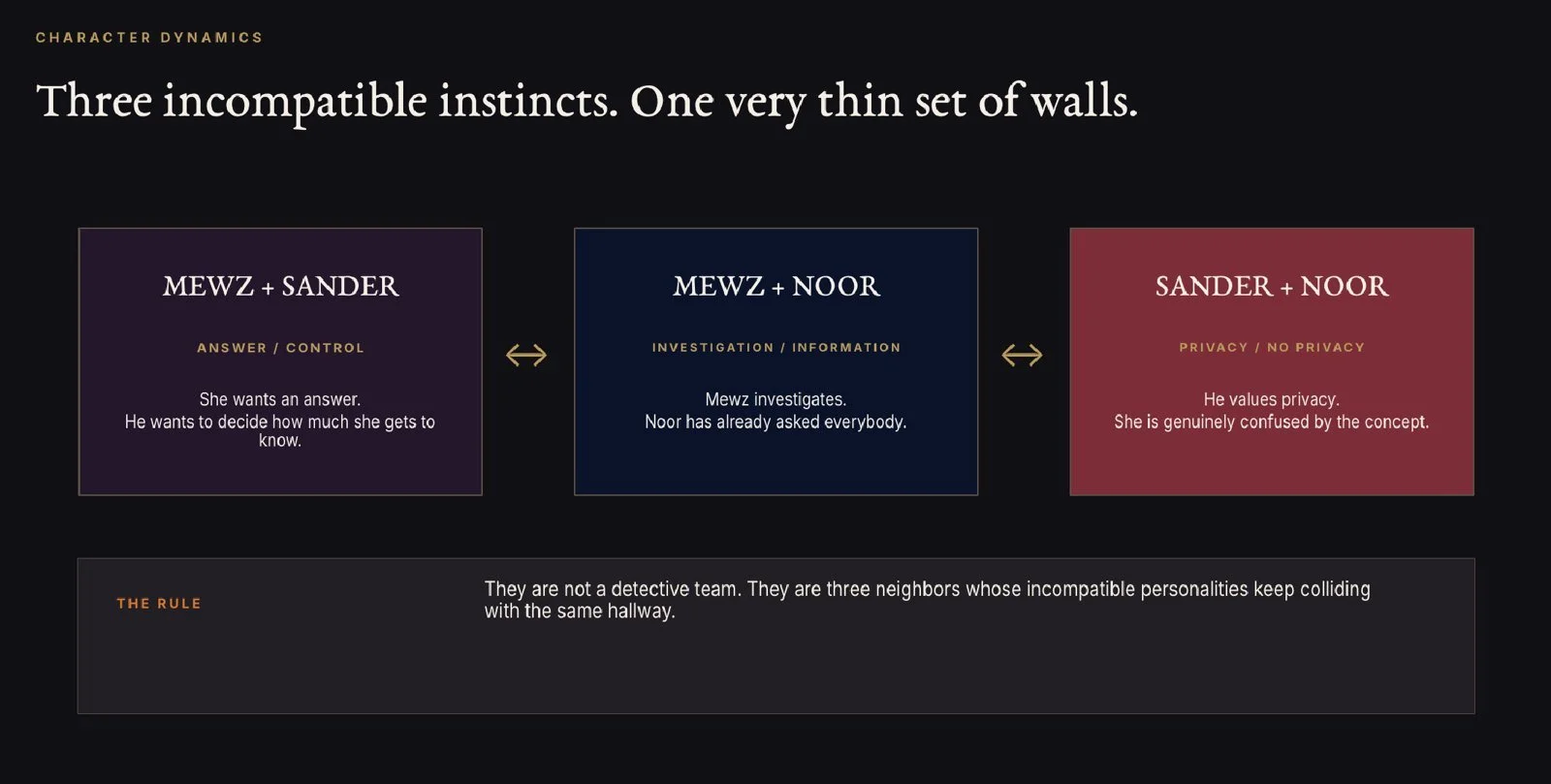
Mewz + Sander: She wants an answer. He wants to decide how much she gets to know.
Mewz + Noor: Mewz investigates. Noor has already asked everybody.
Sander + Noor: He values privacy. She is genuinely confused by the concept.
They are neighbors with incompatible habits, not a detective team. Sander protects a boundary; Noor scarcely recognizes it; Mewz turns the friction into a case.
04 / From pitch to pilot
The decisions become scenes.
The Eleven O'Clock Shuffle
The Eleven O'Clock Shuffle begins at 10:59 PM. A thud, a scrape, and a woman's cry become timed entries in Mewz's notebook. The pilot makes the pitch visible through behavior: Mewz builds a case, Noor offers literal answers, and Sander blocks the view behind his door.
Deck 3–4 → Pilot p. 1
Observation becomes a theory
Give Mewz an observable pattern and let her language outrun what it proves.
MEWZ (V.O.)Eleven o'clock. Right on schedule. Either the man upstairs has a routine or a body.
The opening pairs a precise time with an extravagant inference. Her notebook makes that habit playable: an act of observation becomes a record of suspicion.
Deck 6–7 → Pilot p. 4
Helpfulness leaves room for misunderstanding
Let Noor answer literally while Mewz expects a complete account.
MEWZYou waited until now to tell me that?
NOORYou waited until now to ask.
The exchange makes their mismatch audible. Noor treats a question as the limit of the answer; Mewz expects the missing context to arrive on its own. Their different assumptions create the misunderstanding.
Deck 5, 7, 9 → Pilot p. 3
A boundary becomes an obstacle
Make Sander’s boundary an action, then give it a comic reply.
MEWZThat was not an answer.
SANDER (O.S.)It was a door.
He blocks the view and closes the door. The reply refuses Mewz’s premise while keeping his control of access concrete: she has reached a physical limit as well as a conversational one.
Deck 10, 14 → Pilot p. 4
The tone changes with the point of view
Write the transition between Mewz’s imagined scene and the ordinary room into the action.
For a breath, Mewz sees the hallway as pure noir: deep shadow, a dragged shape, a hand disappearing behind a closing door. A KNOCK snaps the room back to normal.
The brief noir image belongs to her interpretation. A knock interrupts it. The screenplay establishes the tonal change through a specific cut in attention, rather than asking dialogue to explain the joke.
The tonal rule
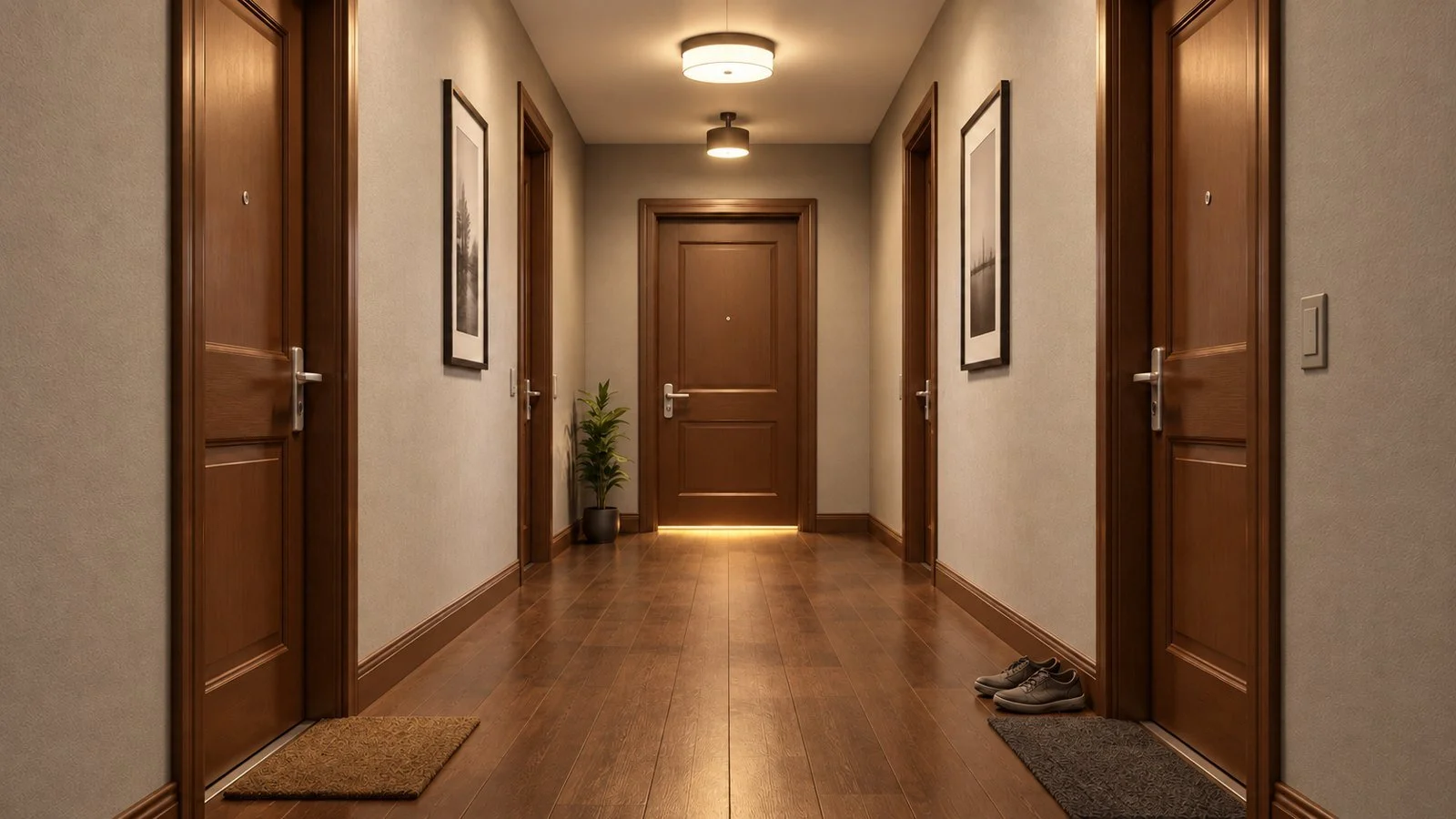
Noir in her head.
Comedy in reality.
The same place can support two readings. Shadow and selective light lend Mewz’s suspicions authority; ordinary illumination restores the shoes, doormats, and small domestic facts she has promoted into implications. The pilot makes that shift explicit in the action above.
05 / Developing the series
Different disturbances.
The same need for an answer.
Six episode concepts vary the material Mewz interprets—sound, delivery, repair, occupancy, familiarity, and restricted space—while preserving her position at the center of the investigation.
The Eleven O'Clock Shuffle
Late-night sounds
Timing and sound become a theory.
Return to Sender
A parcel disappears and returns
An altered label makes an ordinary delivery suspicious.
The Eight O'Clock Handyman
Repairs after dark
Work without context looks like a breach.
Nobody Lives in 4C
Activity in a vacant apartment
An assumed absence makes occupancy a mystery.
The Building Knows
Unasked-for familiarity
Noor’s everyday knowledge becomes suspicious when Mewz assigns it a larger significance.
The Locked Roof
Footprints toward a restricted space
A boundary invites a hidden explanation.
Six episode concepts · Premises from pitch deck slides 12–13.
A setting that keeps generating contact.
The deck proposes recurring apartments, corridors, a lobby or mailroom, and shared access points. These spaces bring tenants, visitors, and workers into contact without requiring a new world for every episode. The contained setting supports repeatable staging and a recognizable social rhythm.
06 / Deliverables & creative outcomes
The idea holds
on the page.
17
Pitch slides
Premise, characters, relationships, locations, tone, and six episode concepts.
8
Screenplay pages
Pilot screenplay, plus title page.
The Eleven O'Clock Shuffle
The pitch establishes a repeatable story system; the pilot gives that system a particular voice, pace, and set of actions. Observation becomes dialogue, privacy becomes blocking, and a tonal principle becomes a written transition.
Together, the deck and pilot articulate the series’ creative direction and demonstrate its execution on the page.
The building supplies the disturbances. Mewz supplies the story she believes they must be telling.
Character & narrative development
Give the story a way forward.
Have an original story that needs stronger characters or clearer structure? Tell me what already exists and what the work needs to accomplish.
Discuss a Project